

Sitting Jameson Williams last week was a bad call, and KC Concepcion Jr. didn’t get the touches we expected. The answer isn’t to play it safe with every pick. It’s to look harder at playing time, targets and what the opposing defense has actually allowed to that position.
This week, Jonah Coleman has a real chance to take advantage of Carolina’s problems against running backs. Matthew Golden and Parker Washington have appealing receiver matchups that their last box scores don’t fully explain. Breece Hall’s return, Tre Tucker’s shrinking role and Baltimore’s quarterback situation demand a little more caution.
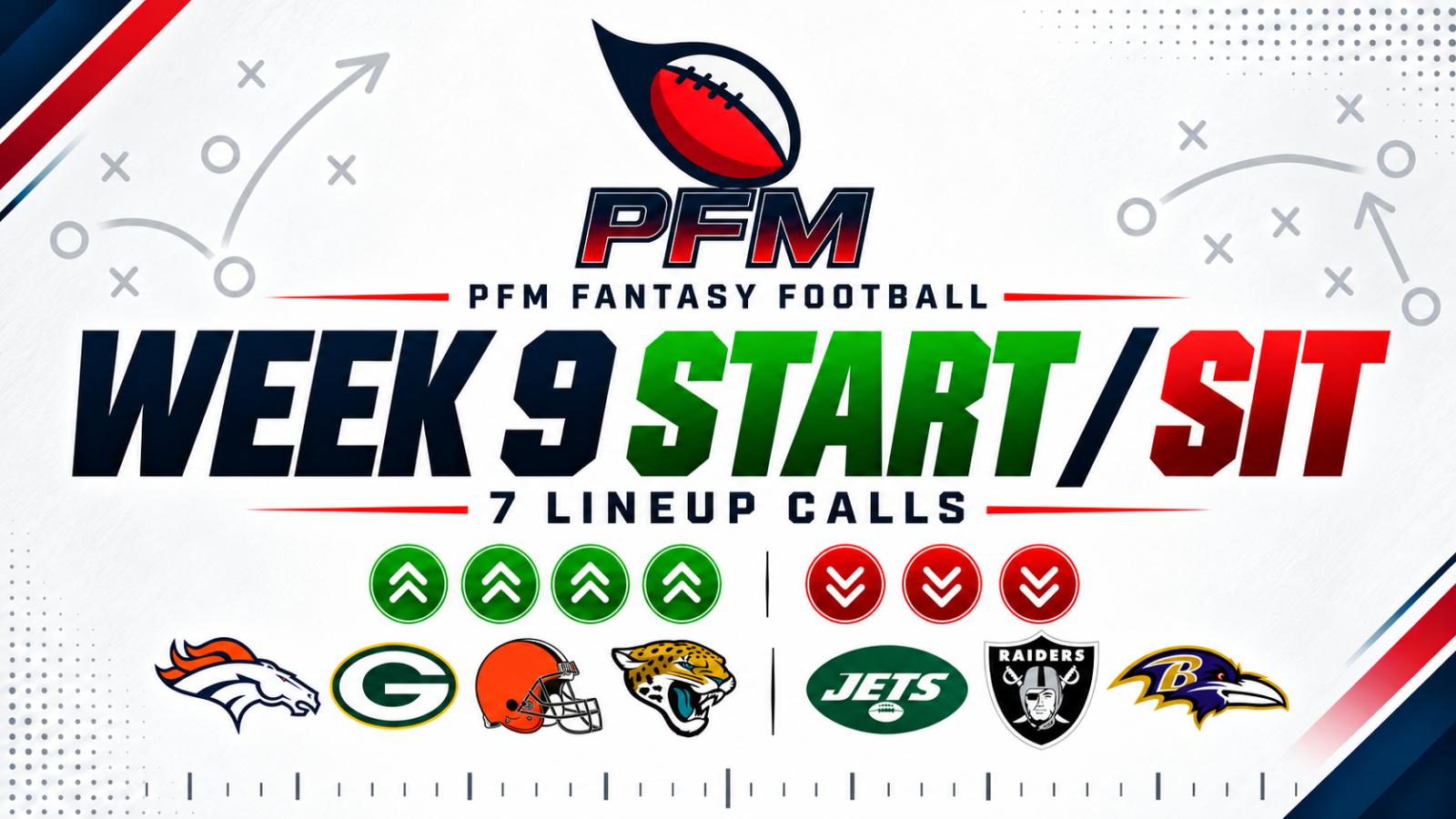
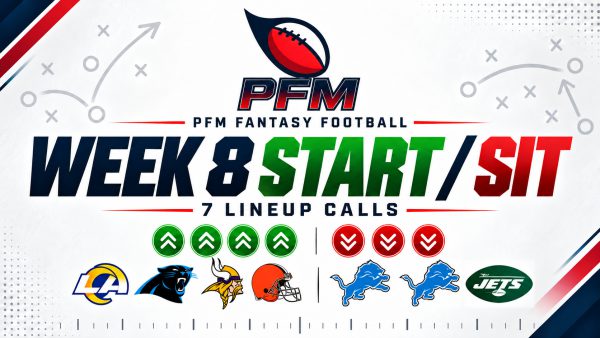
These are four starts and three sits for Week 9 in Half-PPR. Each call comes with the reason it could work, the reason it might not, and a lineup decision worth making.
Scoring:The matchup numbers below are combined Half-PPR points allowed per game to all players at a position through Week 8, not projections for one player. They were independently checked using defense-versus-position results; PFM’s Start/Sit tool uses the same type of QB/RB/WR matchup metric.
My 7 Week 9 Fantasy Football Start/Sit Calls
| Player | Week 9 RankWeek 9 | Opponent | My Call |
|---|---|---|---|
| Jonah Coleman RB · DEN | RB17 | @ CAR | START |
| Matthew Golden WR · GB | WR13 | @ NE | START |
| Harold Fannin Jr. TE · CLE | TE5 | @ NO | START |
| Parker Washington WR · JAC | WR14 | @ BAL | START |
| Breece Hall RB · NYJ | RB28 | @ KC | SIT |
| Tre Tucker WR · LV | WR29 | @ SF | SIT |
| Mark Andrews TE · BAL | TE25 | vs JAC | SIT |
Have a Different Week 9 Decision?
Deciding between two players? Use the PFM Start/Sit tool, and confirm it displays Week 9 before trusting the comparison. Our current Half-PPR rankings cover the full lineup, while recent usage and updated injuries can settle a close call.

Jonah Coleman: Carolina Is a Matchup Worth Attacking
The most important number from Denver’s win over Kansas City isn’t Jonah Coleman’s yardage. It’s 41 snaps to J.K. Dobbins’ 13. Coleman gained 104 yards from scrimmage, caught passes and stayed on the field while the Broncos were trying to finish the game. That is the kind of usage a fantasy manager can build around.
Now as we look at the matchup there are more things to like. Carolina has allowed 26.1 Half-PPR points per game to opposing RBs, the second-most in the league through Week 8. That figure covers every back Carolina has faced, not a projection for Coleman. Dobbins can still take carries, especially near the goal line, but the combination of Coleman’s recent playing time and a defense giving up that much RB production makes the RB17 ranking compelling.

Matthew Golden: This Receiver Matchup Is Better Than It Looks
Matthew Golden saw 13 targets against Carolina after getting 12 the previous week. That’s 25 chances in two games, and PFM’s advanced receiver numbers put him at a 27.2% target share with 1,165 air yards on the season. His 14.2-yard average depth of target tells us Jordan Love is giving him opportunities downfield, not just short catches.
New England’s reputation as a solid overall defense isn’t the same as its fantasy results against receivers. The Patriots have allowed 27.8 Half-PPR points per game to opposing WRs, a more inviting figure than the overall team ranking suggested. Christian Watson will still draw targets, and Golden needs to clean up the drops, but a receiver getting this much work deserves to stay in the lineup. The matchup adds to his case instead of taking away from it.
Harold Fannin Jr.: The Targets Come With a Friendly TE Matchup
Harold Fannin Jr. just caught 10 passes for 154 yards against Pittsburgh, but the part that matters most is the work behind it: 12 targets and 42 routes. He also caught six passes for 91 yards against Tennessee the week before. Cleveland is giving him a real role in the passing game rather than waiting for one touchdown to save his fantasy week.
New Orleans has allowed 13.8 Half-PPR points per game to tight ends through Week 8, one of the friendlier TE matchups in the league. That’s an independent tight-end defense-versus-position figure, not a metric currently displayed in PFM’s Start/Sit tool. Fannin may not get 12 targets every Sunday, and the fumbles are worth monitoring, but his recent routes and catches make him more trustworthy than the typical touchdown-or-bust tight end.

Parker Washington: Baltimore’s WR Matchup Favors a Rebound
Parker Washington managed one catch for 16 yards on two targets against Indianapolis. That’s a disappointing fantasy game, especially when Jacksonville scored 42 points. But Trevor Lawrence didn’t need to throw often with the Jaguars in control. PFM’s receiver stats still show Washington with 48 targets, a 24.6% target share and 618 air yards this season.
Here’s the part last week’s box score hides: Baltimore has allowed 28.6 Half-PPR points per game to opposing wide receivers, one of the more forgiving WR matchups entering Week 9. That doesn’t guarantee Washington gets eight targets on Thursday. The Ravens’ quarterback situation could turn the game into another afternoon when Jacksonville doesn’t have to throw much. Still, a receiver with Washington’s season-long involvement and this matchup is a much better bet than his two targets last week suggest.

Breece Hall: Kansas City Gives His Return Little Margin
Breece Hall is expected to return after missing five straight games with a quad injury. That’s a real decision if he’s on your roster, especially with Braelon Allen proving he can handle the job. PFM’s running back stats show Allen with 112 carries for 565 yards, an average of 5.04 yards per rush. The Jets don’t need to rush Hall back into every carry to have a functional running game.
The matchup gives New York another reason not to force the issue. Kansas City has allowed just 17.5 Half-PPR points per game to opposing running backs, a tougher RB matchup than Carolina is for Coleman. Those points are shared across an opponent’s entire backfield. Hall’s receiving ability can still produce a useful fantasy day, but getting a reduced piece of a difficult matchup is not what managers want from a borderline RB2.

Tre Tucker: The Routes, Not the 49ers, Drive This Sit
Tre Tucker’s zero catches against the Jets were frustrating, but the playing time is the bigger issue. With Jack Bech back, Tucker played 54% of the offensive snaps and ran a route on 63% of dropbacks. PFM’s receiver stats give him a 17.2% target share and a 13.4-yard average depth of target. That’s a risky combination when he’s not consistently on the field for passing plays.
San Francisco has allowed 23.7 Half-PPR points per game to wide receivers. That’s a less generous WR matchup than New England or Baltimore, but it is not proof that the 49ers are a top-five fantasy defense against the position. This sit is mainly about Tucker’s opportunity. Kirk Cousins can lean on Brock Bowers and other targets while Tucker waits for a downfield shot. One long catch could change his afternoon; the recent route totals make it difficult to count on enough chances.

Mark Andrews: Jacksonville Has Been Stingy Against TEs
Mark Andrews hasn’t topped 5.3 PPR points in four straight games, and Baltimore’s quarterback situation adds another obstacle. Undrafted rookie Joe Fagnano is in line for his first NFL start Thursday because Lamar Jackson and Tyler Huntley are injured. He went 10-of-21 for 91 yards and an interception against Buffalo. PFM’s advanced QB numbers put that short appearance at minus-0.43 EPA per dropback, a rough first sample.
Jacksonville has allowed only 8.9 Half-PPR points per game to opposing tight ends through Week 8. That figure comes from independent TE matchup data; PFM’s current Start/Sit tool doesn’t calculate TE defense-versus-position results. So Andrews is dealing with two problems: a difficult TE matchup and an inexperienced quarterback who may need Baltimore to lean more heavily on Derrick Henry. There’s a chance Fagnano looks for Andrews on short throws, but the recent production isn’t enough to assume that will happen.
Week 9: The Matchup Has to Fit the Player
Coleman’s workload and Carolina’s generous RB points allowed work together. Golden and Washington have both earned targets and face defenses giving up real fantasy production to wideouts. Fannin has become a frequent option for Cleveland, with a Saints defense that has been friendly to tight ends. These are starts supported by more than one statistic.
The tougher calls aren’t just about the opponent. Kansas City has limited opposing RB fantasy production, which matters when Hall’s workload is uncertain. Tucker’s route decline worries me more than San Francisco’s name. Andrews has to deal with both a difficult TE matchup and a first-time starting quarterback. Defensive fantasy points allowed are a clue, not a substitute for knowing who’s actually getting the football.
Rankings reviewed November 4, 2026, matchup averages cover the 2026 regular season through Week 8. These are season totals for all players at a position against a defense, not player projections. TE matchup figures are independently sourced because PFM Start/Sit currently supports QB, RB and WR defense comparisons. Jacksonville at Baltimore kicks off Thursday, November 5 at 8:15 p.m. ET. Check final practice reports and Sunday inactives before setting close lineup calls.
Sources & Ranking Review
- PFM rankings: November 4 Week 9 Half-PPR live rankings for late changes.
- Fantasy matchup method: PFM Start/Sit tool compares season and last-three-game opponent points and opportunities allowed for QB, RB and WR. The season points allowed in this article were independently cross-checked and are not represented as exact PFM in-tool output.
- 2026 defense vs position: RB Half-PPR points allowed; WR Half-PPR points allowed; TE Half-PPR points allowed (independent source); through Week 8. Averages are for the whole position group.
- PFM advanced stats: WR targets, target share, air yards and aDOT; RB carries and rushing efficiency; QB EPA.
- NFL schedule: Week 9 schedule and opponents.
- Player usage and availability: Coleman; Golden; Fannin; Hall; Tucker; Baltimore quarterbacks.








Leave a comment